The usual Bordeaux story is inheritance. A classification, a negociant, a century of other people saying the name. Vignobles Sullivan’s story is shorter and sharper. In a handful of years the collection became one of the lists drinkers seek on purpose — Forbes and James Suckling in the margins, a Grand Classement ranking at the top of the region, a label that traveled onto television — while the wine stayed where it was made.
The center of gravity is Château Gaby, Canon-Fronsac, about forty acres of clay-limestone hillside, winegrowing since the 1660s. Tom Sullivan’s grand vin, the Princess from the young vines, and a Cuvée signed and numbered by Damien Landouar. Decanter called the style a blockbuster Fronsac. The 2014 carries 94 points from Forbes. The Cuvée’s own portrait cites 95, and Le Grand Classement has ranked that cuvée No. 1 and No. 7 in Bordeaux.
Around Gaby, the maison filled in the Right Bank rather than collecting logos. Château Du Parc is Saint-Émilion Grand Cru, Merlot and Cabernet Franc with Dr. Alain Raynaud and Landouar, 95 points from Forbes. Clos Beauséjour is Pomerol at a ridiculous scale — one of the smallest vineyards there, 163 cases for the United States, 97 from Tom Mullen and 93 from James Suckling. Moya is organic Castillon, next to Saint-Émilion, bottled at the château. Auguste is the estate that keeps the house human: blanc, rosé, a twenty-four-dollar rouge, and Le’ Zilch, a dealcoholized red certified by ECOCERT.
Two farming sentences are specific enough to repeat. At Auguste and Moya, music is played to the vines at dawn and dusk. The process is called Genodics. The claim is agricultural, not mystical: plumper fruit, better resistance to fungus. The Grand Rosé is hand-picked with stems attached. Nothing in the bottle is bulk wine with a château capsule.
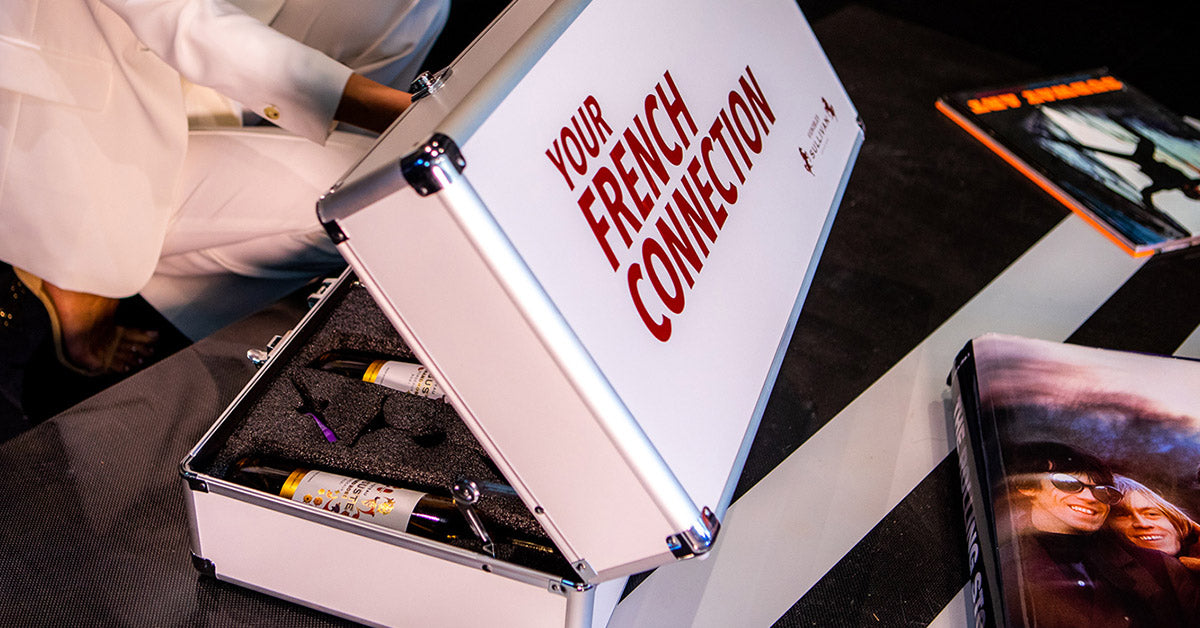
The United States is not a footnote. It is where the collection is sold, at vsatsr.com. Single bottles and cases. Free-shipping offers printed on each wine. The photographs on these pages are the shop’s own — the cellar, the case, the labels — because the story is not improved by stock vineyards.
If you want the absolute bottle, start with the Cuvée or the Pomerol. If you want the argument of the house, start with Gaby 2014 and do not stop until you have tasted Princess beside it. The full map is the cellar.